

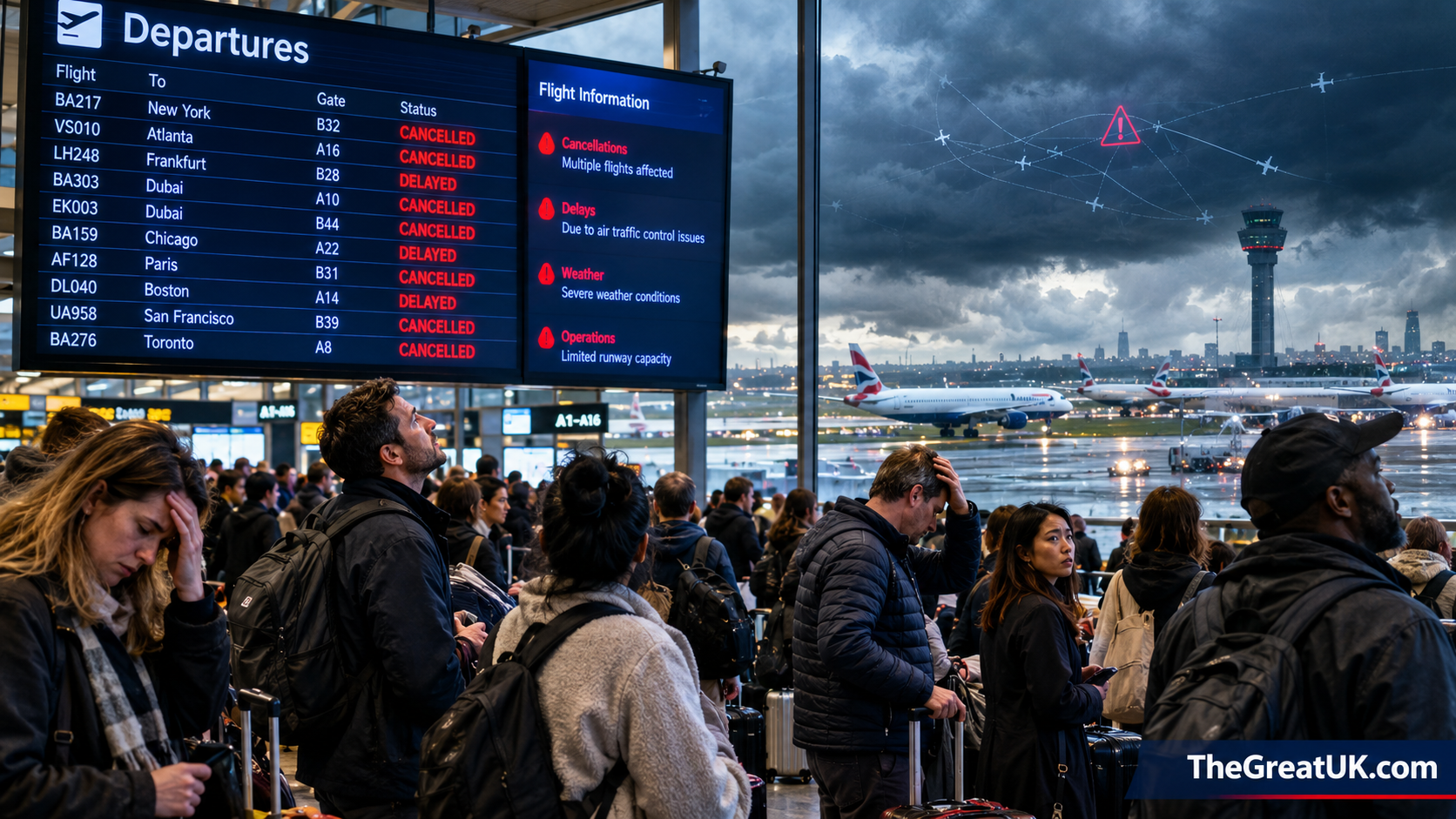
UK Air Traffic Control Chaos: 1,000+ Flights Cancelled as NATS Boss Faces Transport Secretary
UK air traffic control chaos is far from over. Thousands of passengers have been caught up in cancellations, long delays and disrupted travel after a major technical failure hit National Air Traffic Services (NATS), the organisation responsible for managing much of Britain’s air traffic.
The technical problem was eventually fixed, but that was only the beginning of the headache.
With aircraft and crews left in the wrong places, airports struggling to clear the backlog and airlines cancelling flights, the disruption is expected to continue even after the main system fault has been resolved.
The situation has also turned into a serious question for the UK aviation industry: How can a relatively short technical failure create such enormous disruption across the country’s airports? @Canelo Álvarez Latest News 2025 @AstonVilla
The spotlight is now firmly on NATS chief executive Martin Rolfe, who is facing the Transport Secretary, Heidi Alexander, as the government seeks answers over what went wrong and what needs to change.
Latest UK Air Traffic Control News: What Happened?
The trouble began on Tuesday, 8 September, when NATS experienced a technical problem affecting its flight data processing system.
The failure affected operations at several major UK airports, including Heathrow, Gatwick, Manchester and Stansted.
At one point, flight operations were heavily restricted, creating a domino effect across the aviation network.
According to FlightRadar24 data reported by major news organisations, more than 1,000 flights were cancelled on Tuesday, while hundreds more were delayed. Reuters reported that around 1,300 flights had been cancelled by the end of Tuesday, while other reports placed the figure at just over 1,000 depending on the reporting cut-off.
Read More From Major News Outlets
Reuters – UK air traffic control disruption
The Guardian – UK air traffic control breakdown
The Independent – NATS boss faces Transport Secretary
Associated Press – UK flight chaos and cancellations
Financial Times – Heathrow and Gatwick disruption
NATS later confirmed that the technical issue had been resolved and said its systems were operating normally.
But passengers quickly discovered that fixing the software did not mean everything could immediately return to normal.
That is because aviation is an interconnected system. If hundreds of aircraft do not reach their planned destinations, pilots and cabin crew can also end up in the wrong locations.
One cancelled flight can therefore create another cancellation several hours later.
And another.
And another.
That is exactly why the UK is still experiencing the effects of Tuesday’s failure.
Why Are Flights Still Being Cancelled After the NATS Problem Was Fixed?
This is probably the biggest question passengers are asking.
If NATS fixed the technical issue, why are flights still being cancelled?
The answer is the aviation industry’s dreaded knock-on effect.
Imagine an aircraft scheduled to fly from London to Spain, then Spain to Manchester, followed by Manchester to another European destination.
If that aircraft is stuck in London for several hours because of an air traffic restriction, the entire schedule can collapse.
The same applies to pilots and cabin crew.
They have legal working-hour limits and cannot simply continue flying indefinitely to repair the schedule.
As a result, airlines have to reposition aircraft, find available crews and reorganise thousands of passenger bookings.
The Guardian reported that at least 177 flights scheduled for Wednesday had already been cancelled, with the majority at Heathrow.
The Independent also reported that further disruption was expected as airlines dealt with the consequences of Tuesday’s cancellations and delays.
The Heathrow Problem
Heathrow has been one of the most visible centres of the disruption.
It is one of the world’s busiest airports, so even a temporary reduction in capacity can have a huge impact.
When flights are delayed at Heathrow, the consequences are not necessarily limited to the UK.
Flights connecting through London can affect passengers travelling between Europe, North America, Asia, the Middle East and other parts of the world.
That is why a UK air traffic control failure can quickly become an international aviation story.
More Useful News References
ABC News – Passengers stranded at Heathrow
RTE – Irish flights affected by UK disruption
The National – UK airports affected by NATS issue
Economic Times – UK flight cancellations update
LBC – Latest passenger disruption and NATS response
NATS Boss Martin Rolfe Under Pressure
The technical failure has quickly become more than a travel inconvenience.
It has become a leadership issue.
NATS chief executive Martin Rolfe has accepted responsibility for the disruption and expressed sympathy for passengers caught up in the chaos.
However, he has not indicated that he intends to resign.
That has not stopped airlines from demanding action.
Ryanair has called for Rolfe’s resignation, arguing that passengers and airlines have suffered from repeated failures.
Wizz Air has also called for major reform, arguing that a critical piece of national infrastructure should not repeatedly cause widespread disruption.
The pressure is particularly significant because this is not the first serious NATS-related disruption in recent years.
The UK experienced a major flight-planning failure in August 2023, which caused widespread cancellations and delays.
There was also another significant technical incident in 2025.
That history makes the latest failure much harder for NATS to dismiss as simply an unfortunate one-off.
And this is where the story gets politically interesting.
Transport Secretary Heidi Alexander Wants Answers
Transport Secretary Heidi Alexander is now expected to receive a detailed briefing from NATS chief Martin Rolfe.
The government wants to know what caused the latest failure, why the disruption spread so quickly and whether the UK’s air traffic control infrastructure has enough resilience.
Alexander has already acknowledged passengers’ frustration and said she wants assurances that lessons will be learned.
That message will be closely watched by airlines, airports and passengers.
Because the question is no longer simply:
“When will my flight leave?”
The bigger question is:
“Can Britain’s air traffic control system be trusted to cope with another failure?”
The Civil Aviation Authority (CAA) has also been involved.
The regulator expects NATS to provide a full report on the incident and will then consider whether additional measures are necessary to improve the reliability of the UK’s air traffic control system.
Why This Meeting Matters
The meeting between the NATS boss and Transport Secretary could become one of the most important moments in the aftermath of the disruption.
There are several issues sitting on the table:
- What exactly caused the technical failure?
- Why did the system fail in the first place?
- Were backup systems available?
- Did contingency plans work as expected?
- Why did recovery take so long?
- Could another failure produce similar disruption?
- Does NATS need additional investment?
- Should the organisation change its leadership or operating structure?
For passengers, these questions may sound technical.
But they matter.
A reliable air traffic control system is a fundamental part of modern travel.
#UKFlightChaos: Why This Story Is Bigger Than One Bad Day
#UKFlightChaos has become an easy way to describe the situation, but behind the hashtag is a much bigger aviation problem.
Britain operates some of the busiest and most complicated airspace in Europe.
Thousands of flights cross the country’s skies every day.
That means the system needs to be not only efficient but also incredibly resilient.
A failure lasting a few hours can create disruption lasting much longer.
Think of it like a motorway.
If one major junction closes for four hours, traffic does not magically disappear when the junction reopens.
The queue remains.
That is essentially what has happened in Britain’s aviation network.
Planes were unable to operate normally.
Passengers missed connections.
Aircraft ended up in the wrong airports.
Crews became unavailable.
Airlines then had to rebuild their schedules.
That rebuilding process takes time.
What Does This Mean for Passengers Flying From UK Airports?
If you have a flight from Heathrow, Gatwick, Manchester, Birmingham, Stansted, Luton, Bristol or another affected airport, do not assume your flight will operate simply because NATS says the technical problem has been fixed.
The system may be working normally while your individual flight is still affected by the backlog.
The best approach is simple.
1. Check your airline first
Airlines generally have the most specific information about individual bookings.
Check your airline’s website or app before travelling to the airport.
2. Check the airport’s departure board
Airport information can change quickly.
A flight that appears delayed may later be cancelled, while another flight may depart close to its original schedule.
3. Don’t rely only on social media
Social media can be useful for breaking updates, but passengers should verify important travel information through their airline or airport.
4. Allow extra time
If your flight is operating, expect airports to be busier than usual.
5. Keep your travel documents accessible
If your flight is cancelled and you are rebooked, having your booking reference and travel documents ready can make the process easier.
Could the UK Air Traffic Control Crisis Get Worse?
At the moment, the main technical issue has been resolved, but the operational recovery is still underway.
That distinction is important.
NATS can have functioning computer systems while airlines are still dealing with hundreds of disrupted flights.
The aviation network needs time to reset.
The bigger concern is what happens next.
If the investigation finds that the failure was caused by a weakness that could happen again, pressure on NATS and the government will increase dramatically.
The CAA has already indicated that it expects a full incident report.
Meanwhile, airlines are calling for reform.
This could potentially lead to changes in contingency planning, system redundancy, technology investment and oversight.
The Bigger Lesson for British Aviation
The latest disruption has exposed a simple but uncomfortable reality.
Modern aviation depends heavily on technology.
Passengers see aircraft.
Pilots see flight instruments.
Airports see departure boards.
But behind all of that is a huge digital network coordinating aircraft movements.
When that network works, everything looks effortless.
When it fails, the consequences can be enormous.
The 2026 NATS disruption is therefore not just about cancelled flights.
It is about resilience, infrastructure and public confidence.
Britain’s aviation sector cannot afford to treat major technical failures as isolated inconveniences forever.
Passengers want to know that when they buy a ticket, the systems supporting their journey are reliable.
Airlines want predictable operations.
Airports want stable traffic flows.
And the government wants confidence that critical national infrastructure can withstand technical problems.
That is why the meeting between Martin Rolfe and Heidi Alexander matters.
Frequently Asked Questions About the UK Air Traffic Control Chaos
1. What caused the UK air traffic control disruption?
NATS reported a technical issue affecting its flight data processing system. The problem disrupted flight operations at several major UK airports.
2. Has the NATS technical problem been fixed?
Yes. NATS said the system issue had been resolved and that it was operating normally. However, the resulting backlog of flights and misplaced aircraft and crews means disruption can continue.
3. How many flights were cancelled?
More than 1,000 flights were cancelled on Tuesday, according to flight-tracking data reported by major news organisations. Different reports give slightly different totals depending on the time at which the data was collected.
4. Are flights still being cancelled today?
Yes. Further cancellations and delays are expected as airlines work through the backlog created by Tuesday’s disruption.
5. Which UK airports have been affected?
Major airports including Heathrow, Gatwick, Manchester and Stansted have experienced disruption. Other airports have also reported delays or cancellations.
6. Who is Martin Rolfe?
Martin Rolfe is the chief executive of NATS, Britain’s main air navigation service provider.
7. Is Martin Rolfe resigning?
There is currently no indication that Rolfe has announced his resignation. However, Ryanair has called for him to step down following the latest disruption.
8. Who is Heidi Alexander?
Heidi Alexander is the UK’s Transport Secretary. She is expected to receive a briefing from the NATS chief about the technical failure and its consequences.
9. Is it safe to fly?
NATS said that safety was not compromised by the technical issue. The problem primarily caused operational disruption, delays and cancellations. Passengers should still follow the latest information from their airline and airport.
10. Why can a short technical failure cause hours of delays?
Airlines operate tightly connected schedules. If aircraft and crews are stuck in the wrong locations, later flights may also be delayed or cancelled. This creates a knock-on effect across the network.
11. Is this the first major NATS failure?
No. Britain has experienced significant air traffic control disruption in previous years, including a major flight-planning failure in 2023 and another technical incident in 2025.
12. What should passengers do if their flight is affected?
Check your airline’s website or app, confirm your flight status before leaving for the airport and follow the airline’s instructions regarding rebooking, refunds or alternative travel arrangements.